Pliny?s Natural History was an intellectual marvel in its day, and indispensable to later generations as an encyclopedia of antique knowledge of the natural world. It was also one of the first books to appear in print. The first translation of the Natural History into the vernacular was published by the Strozzi family of Florence in 1476. It was printed by Nicolas Jenson, the great Venetian printer, and this magnificent copy, on vellum, was specially illuminated for the banker Filippo Strozzi, who underwrote the edition. As well as an elaborate opening pages there are exquisite historiated initials and borders at the start of each of the thirty-seven books, many of them incorporating the Strozzi coat of arms, as well as hundreds of decorated initials within the text.
With a bibliographical note by Sydney Cockerell, and a note by Emery Walker on flyleaf about Morris’s ownership of the book.
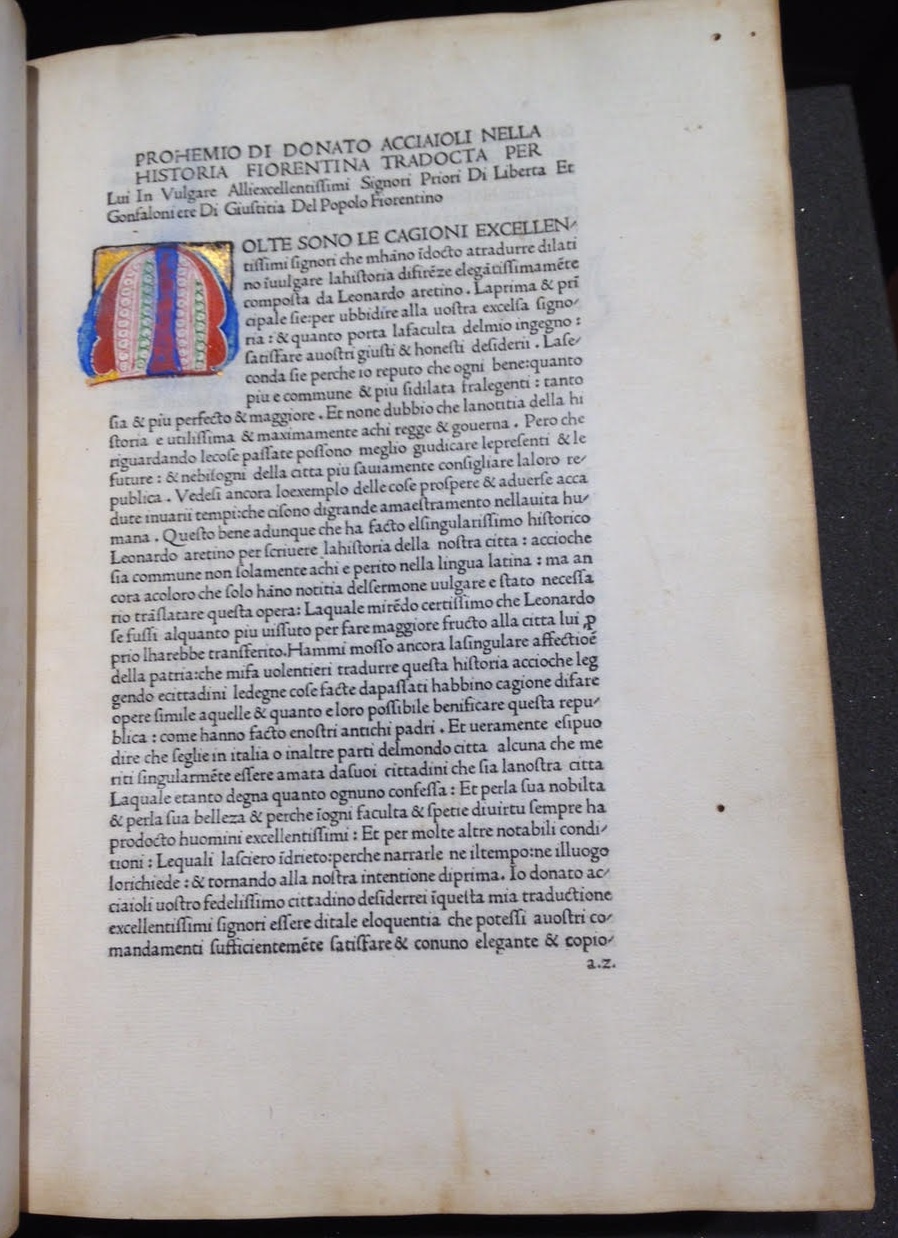
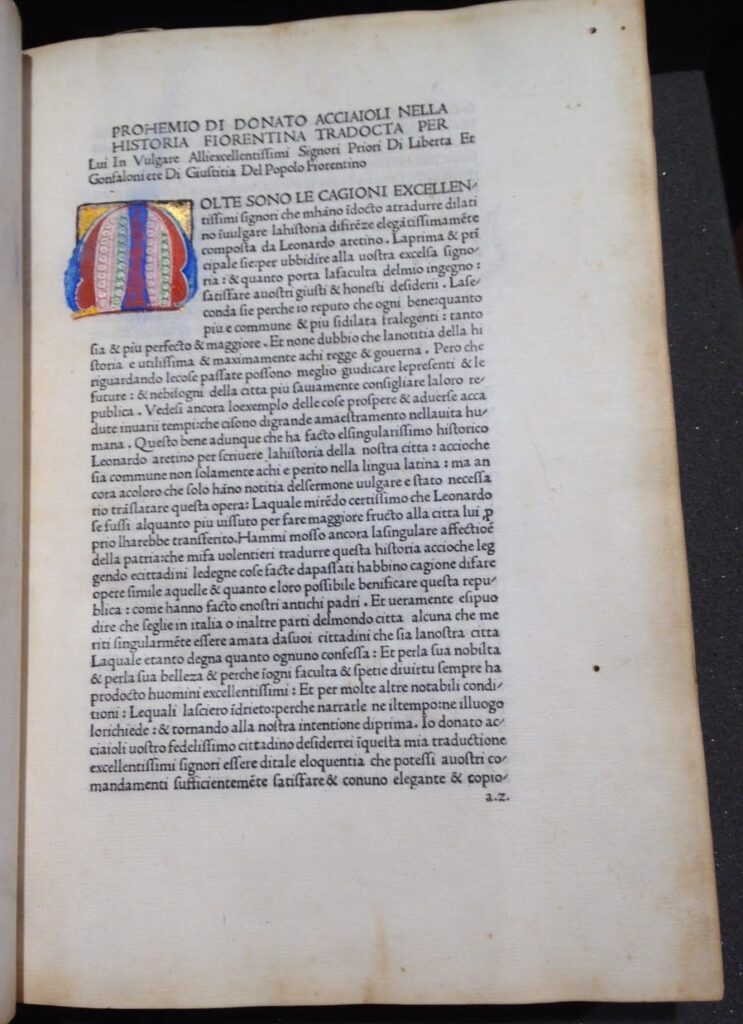
According to Cockerell, in about 1889 Morris began collecting older books “with the definite purpose of studying the type & methods of the early printers. Among the first books so acquired was a copy of Leonard of Arezzo’s History of Florence, printed at Venice by Jacobus Rubeus in 1476, in a Roman type very similar to that of Nicholas Jenson. Parts of this book and of Jenson’s Pliny of 1476 were enlarged by photography in order to bring out more clearly the characteristics of the various letters; and having mastered both their virtues and defects, William Morris proceeded to design the fount of type which, in the list of December, 1892, he named the Golden type . . .” (A Note by William Morris on His Aims in Founding the Kelmscott Press [Hammersmith: Kelmscott Press, 1898], pp. 11–12). The Doves type, later created under the supervision of Walker, was also based on the font used in this book.
Provenance: Christoph Schuerl. — Frederick Perkins. — Bernard Quaritch. — Morris (purchased from Quaritch for £2 10s.). — Richard Bennett. — Sotheby 1898, lot 132 (sold to Leighton for £6). — Emery Walker. — Meisei University Library.
Facsimile of a page of Herodotus, printed at Venice by Giovanni and Gregorio de’ Gregorii, 1494 Antique wood engraving, 1880 Caption below picture: ‘Facsimile of a page of Herodotus, printed at Venice by Giovanni and Gregorio de’ Gregorii, 1494′ VENICE/TOWNS: Facsimile of a page of Herodotus, printed at Venice by Giovanni and Gregorio de’ Gregorii, 1494; Antique wood engraving, 1880; approximate size 31.0 x 20.5cm, 12.25 x 8.25 inches DATE PRINTED: 1880 IMAGE SIZE: Approx 31.0 x 20.5cm, 12.25 x 8.25 inches (Large) ARTIST/CARTOGRAPHER/ENGRAVER: Unsigned PROVENANCE: “Venice – its history – art – industries and modern life”, by Charles Yriarte, translated from the French by F.J. Sitwell; published by George Bell & Sons, London TYPE: Antique wood engraving VERSO: There are images and/or text printed on the reverse side of the picture. In some cases this may be visible on the picture itself (please check the scan prior to your purchase) or around the margin of the picture CONDITION: Good; suitable for framing. Please check the scan for any blemishes prior to making your purchase. Virtually all antiquarian maps and prints are subject to some normal aging due to use and time which is not obtrusive unless otherwise stated. I offer a no questions asked return policy – see below. Orders normally mailed within 2 business days of
Erhard Ratdolt (1442–1528) was an early German printer from Augsburg.[1] He was active as a printer in Venice from 1476 to 1486, and afterwards in Augsburg. From 1475[1] to 1478 he was in partnership with two other German printers.[1]
The first book the partnership produced was the Calendarium (1476), written and previously published by Regiomontanus, which offered one of the earliest examples of a modern title page. Other noteworthy publications are the Historia Romana of Appianus (1477), and the first edition of Euclid’s Elements (1482), where he solved the problem of printing geometric diagrams, the Poeticon astronomicon, also from 1482, Haly Abenragel (1485),[2] and Alchabitius (1503). Ratdolt is also famous for having produced the first known printer’s type specimen book (in this instance a broadsheet displaying the fonts with which he might print).[3]
His innovations of layout and typography, mixing type and woodcuts, have subsequently been much admired. His graphic choices and technical solutions influenced also those of William Morris.[4]
M25160-136 001
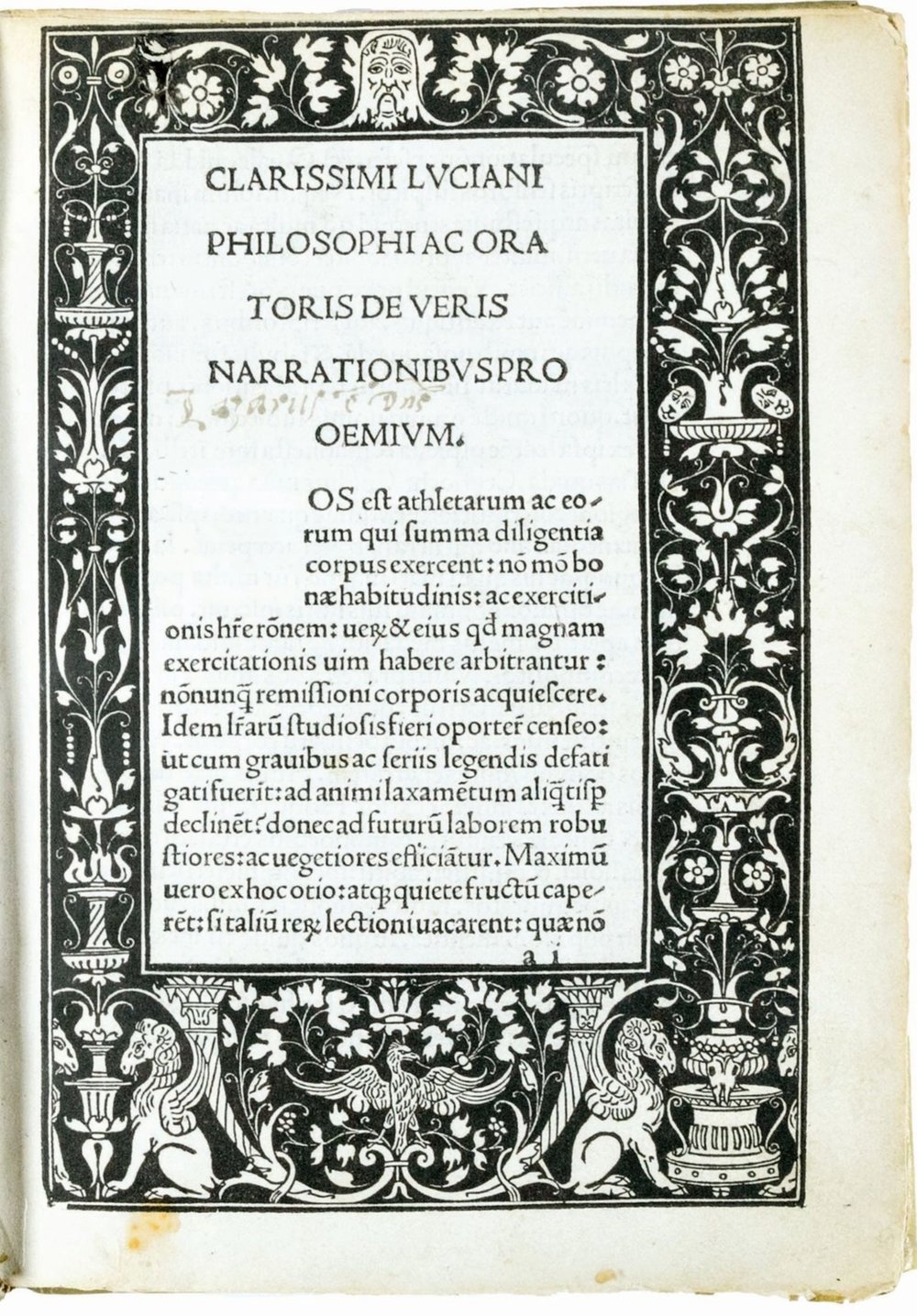
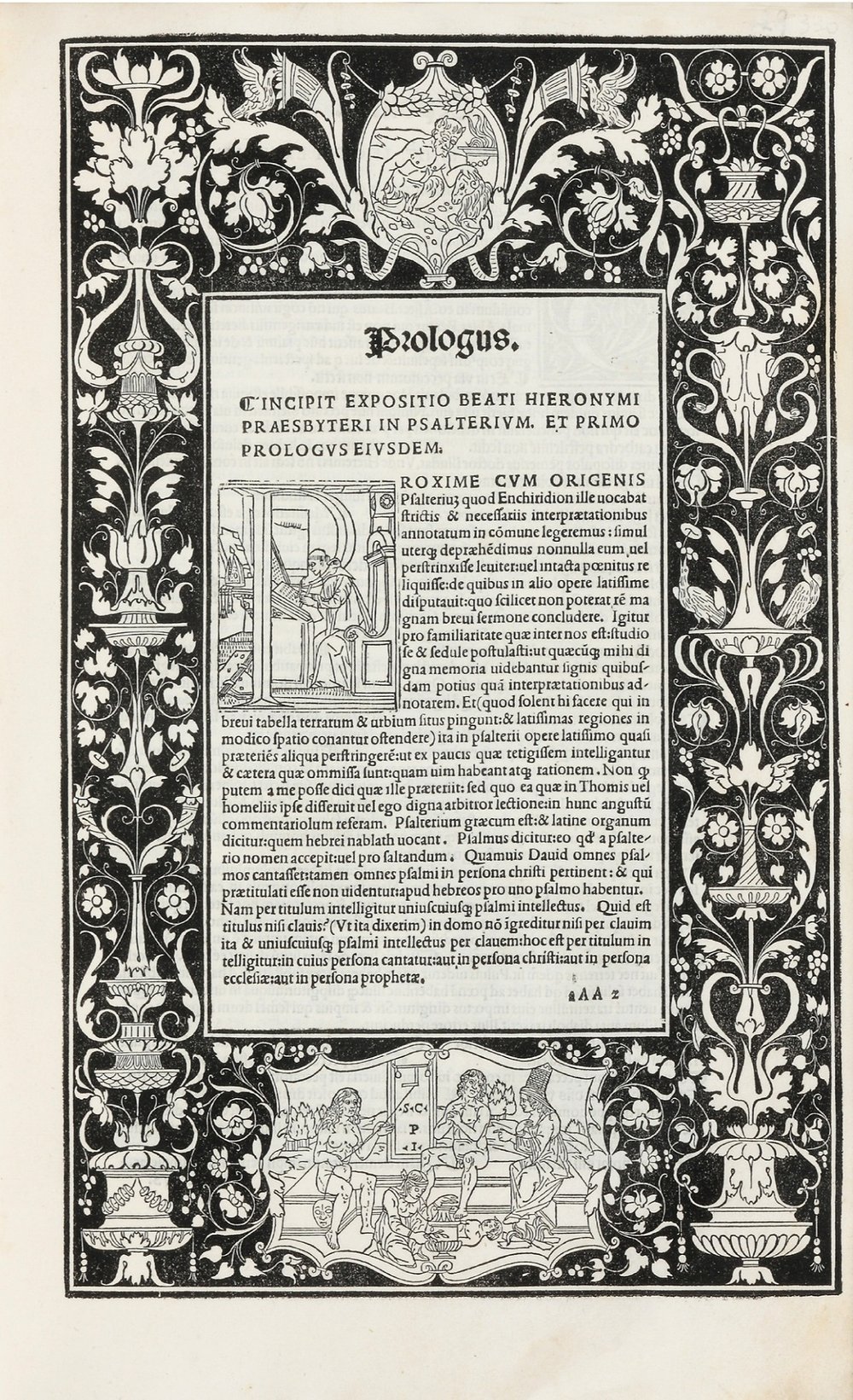
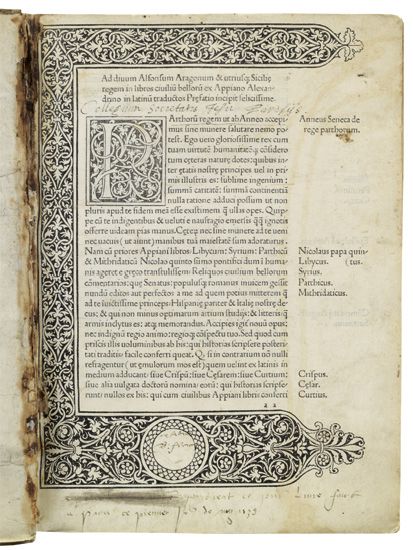
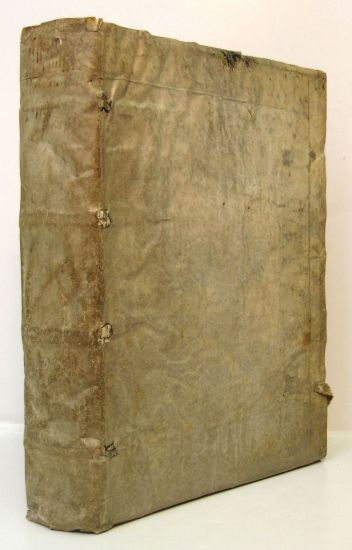
APPIANUS. Historia Romana. Latin translation by Petrus Candidus Decembrius. Part 2 (of 2): De bellis civilibus [and other texts]. [211] (of [212]) leaves: lacks initial blank. Roman type. Woodcut white-on-black three-quarter border on a2r and ornamental initials throughout. 4to, 278×205 mm, early limp vellum with remnants of thong ties; front free endpaper reattached causing slight adhesive discoloration in title gutter, occasional light marginal foxing and soiling. (Venice: Bernhard Maler, Erhard Ratdolt and Peter Löslein, 1477)
APPIANUS. Historia Romana. Latin translation by Petrus Candidus Decembrius. Part 2 (of 2): De bellis civilibus [and other texts]. [211] (of [212]) leaves: lacks initial blank. Roman type. Woodcut white-on-black three-quarter border on a2r and ornamental initials throughout. 4to, 278×205 mm, early limp vellum with remnants of thong ties; front free endpaper reattached causing slight adhesive discoloration in title gutter, occasional light marginal foxing and soiling. (Venice: Bernhard Maler, Erhard Ratdolt and Peter Löslein, 1477)
Appian’s Historia Romana Erhard Ratdolt, 1477 APPIANUS (c.95-165). Historia Romana and De bellis civilibus. Translated by Petrus Candidus Decembrius. Venice: Bernhard Maler (Pictor), Erhard Ratdolt, and Peter Löslein, 1477.
First complete edition of Appian’s Roman History, the Stirling Maxwell copy. According to Redgrave, Ratdolt’s biographer, “to my mind there are few printed books of any age which can be compared with the Appian of 1477, with its splendid black ink, its vellum-like paper, and the finished excellence of its typography.” Composed in Greek, Appian’s history originally comprised 24 books on the history of Rome up to the reign of Vespasian, but only about half the work survived to the age of print. Pier Candido Decembrio, his humanist translator, divided the extant books into two parts: Historia Romana, on the early history of Rome, and De bellis civilis—a vital source for the restless and violent years preceding the dissolution of the Roman republic. This is one of Ratdolt’s earliest Venetian imprints, following only Regiomontanus’s Calendarium, and contains the first use of both fine woodcut border pieces. Part II only first appeared from the press of Vindelinus de Spira in 1472. H 1307* [II, I]; GW 2290; BMC V 244; BSB-Ink A-651; Bod-inc A-363; Essling 221; IGI 763; Goff A-928; ISTC ia00928000.
Two parts in one volume, royal half-sheet quarto (253 x 186mm). 344 leaves. One full-page woodcut border and one partial woodcut border, large and small woodcut initials with vine pattern (portion of initial blank repaired, losing part of a manuscript inscription, light spotting and toning, some very light dampstains). Brown morocco gilt by Leighton with stamped seals of Stirling Maxwell, Maxwell seal on inner board, gilt edges (worn at extremities). Provenance: marginalia (some trimmed), partially cropped early ownership inscription on flyleaf, and faint erased inscription on first text leaf – Johann Christoph Wolffskeel (inscription and initials, fl. c.1550) – Munich Royal Library (stamps, including duplicate mark) – Sir William Stirling Maxwell (1818-1878; bookplate and binding) – acquired from Lathrop C. Harper, Inc, New York, 12 July 1957.
Famous incunabulum, one of the first books that appeared with woodcut ornaments: the borders for both the Historia Romanaand De Bellis Civilibus are an intricate pattern of vines and acanthus leaves, the first here printed in red, a rare process seen only in a very few copies. Usually, these ornaments are simply printed in black. Also, this is the first book with ornaments on a black background, including the large initial on the first page. Contents-wise, this is the first complete edition of the surviving portions of Appian’s Roman History, written in Greek and translated into Latin by Petrus Candidas Decembrius. “Appian of Alexandria (ca. 95-ca. 165) was a Greek historian with Roman citizenship who flourished during the reigns of Emperors of Rome Trajan, Hadrian, and Antoninus Pius. He was born in Alexandria. After holding the chief offices in the province of Aegyptus (Egypt), he went to Rome c. 120, where he practised as an advocate, pleading cases before the emperors (probably as advocatus fisci). It was in 147 at the earliest that he was appointed to the office of procurator, probably in Egypt, on the recommendation of his friend Marcus Cornelius Fronto, a well-known litterateur. Because the position of procurator was open only to members of the equestrian order (the ‘knightly’ class), his possession of this office tells us about Appian’s family background. His principal surviving work ( Ρωμαϊκά Romaiká, known in Latin as Historia Romana and in English as Roman History) was written in Greek in 24 books, before 165. This work more closely resembles a series of monographs than a connected history. It gives an account of various peoples and countries from the earliest times down to their incorporation into the Roman Empire, and survives in complete books and considerable fragments. The work is very valuable, especially for the period of the civil wars. T he Civil Wars, books 13-17 of the Roman History, concern mainly the end of the Roman Republic and take a conflict-based view and approach to history. Despite the lack of cited sources for his works, these books of the Roman History are the only extant comprehensive description of these momentous decades of Roman history.” (Wikipedia). The translator’s division of the extant books into two parts differs slightly in its order from the Greek originals. Leaf numbering is [a-c 10 (a1 blank discarded, as usual) d12, e10-x10; a-i 10 (a1 blank) k-m 8, o10]. a2r is the translator’s dedication to Pope Nicholas V. The blank 11-line space on c1v and all of c2r in part 1 was left by the printers to indicate a gap in the extant manuscripts. The partnership of the printers Erhard Ratdolt and Bernhard Maler and the corrector and editor Peter Loslein lasted from 1476 to 1478. The exceptional beauty of the books printed at their press is characterized by the use of a series of very fine woodcut borders and initials along with a strikingly clear and pleasing roman type.
Although traditionally credited to Ratdolt, the design of the woodblocks and possibly of the type is more likely to have been the work of Bernhard Maler who was in charge of the press. When Ratdolt set up his own press in 1480, he apparently brought only one of the border blocks with him, the one that appears in part II of the present work, which he used again for the 1482 Euclid. The border used in part I appears in this edition only. Provenance: inscribed on the last text page blank verso by the Venetian senator Angelo Gabrieli (1470-1532), writer of a little-known 16 pp. treatise, Libellus hospitalis munificentiae Venetorum in excipienda Anna regina Hungariae (1502). “Anna of Foix-Candale (1484-1506) was Queen of Hungary and Bohemia as the third wife of King Vladislaus II. She incurred debts in Venice and was said to favour this city all her life” (Wikipedia). A few marginalia in a neat old hand. Slight wear to spine ends; first ornament border ever so slightly shaved at the top, a few leaves with minimal marginal spotting but generally remarkably clean: a wonderfully preserved copy. BMC V, 244; Essling, 221; IGI, 763; Redgrave, Ratdolt p. 28 n° 3; Sander, 482.
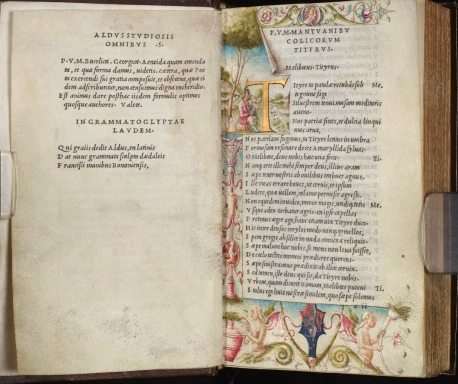
The John Rylands Library copy of the Aldine Virgil, printed on vellum, and illuminated with the coat of arms of the Pisani family of Venice. In the poem on the left page facing Virgil’s text Aldus praised the skill of the punchcutter Francesco Griffo of Bologna who designed the new Italic type. This type, based o the Italian humanist cursive script or Cancellersesca originally developed in the 1420s by the humanist and Niccolò de’ Niccoli, became the model for later Italic types
In April 1501 Venetian scholar printer Aldus Manutius issued an edition of the poems of Virgil (Vergil) in Italic typeOffsite Link designed by the punchcutter Francesco GriffoOffsite Link, also known as Francesco da Bologna. A very skilled craftsman, Griffo was also a “tumultuous character” who ended his life in the hangman’s noose for murdering his son-in-law. This was the first book completely printed in Italic typeOffsite Link, an adaptation of humanist script, possibly Aldus’s own handwriting. Facing the first page of Virgil’s text, Aldus included a poem praising the skill of Griffo who designed the new type. In addition to its elegant design, Italic type had the advantage of a higher character count, allowing more information to be printed legibly in less space than Roman or Gothic type.
Aldus’s edition of Virgil was also the first of a series of volumes that he issued in the pocket, or octavo format. This smaller format had previously been used for editions of devotional texts, but Aldus was the first to use the smaller format to make non-devotional literature available in the more portable format, and at lower cost. Davies pointed out that a signifcant reason for Aldus’s introduction of the octavo format was the collapse of the credit market in Venice in 1500 caused by “Venetian defeats and Turkish advances,” which caused many business failures, and would have motivated Aldus to publish books that could be sold at lower cost.
Albrecht Dürer 21 May 1471 – 6 April 1528), sometimes spelled in English as Durer, was a German painter, printmaker, and theorist of the German Renaissance. Born in Nuremberg, Dürer established his reputation and influence across Europe in his twenties due to his high-quality woodcut prints. He was in contact with the major Italian artists of his time, including Raphael, Giovanni Bellini, and Leonardo da Vinci, and from 1512 was patronized by Emperor Maximilian I.
Dürer’s vast body of work includes engravings, his preferred technique in his later prints, altarpieces, portraits and self-portraits, watercolours and books. The woodcuts series are more Gothic than the rest of his work. His well-known engravings include the three Meisterstiche (master prints) Knight, Death and the Devil (1513), Saint Jerome in his Study (1514), and Melencolia I (1514). His watercolours mark him as one of the first European landscape artists, while his woodcuts revolutionised the potential of that medium.
Dürer’s introduction of classical motifs into Northern art, through his knowledge of Italian artists and German humanists, has secured his reputation as one of the most important figures of the Northern Renaissance. This is reinforced by his theoretical treatises, which involve principles of mathematics, perspective, and ideal proportions.
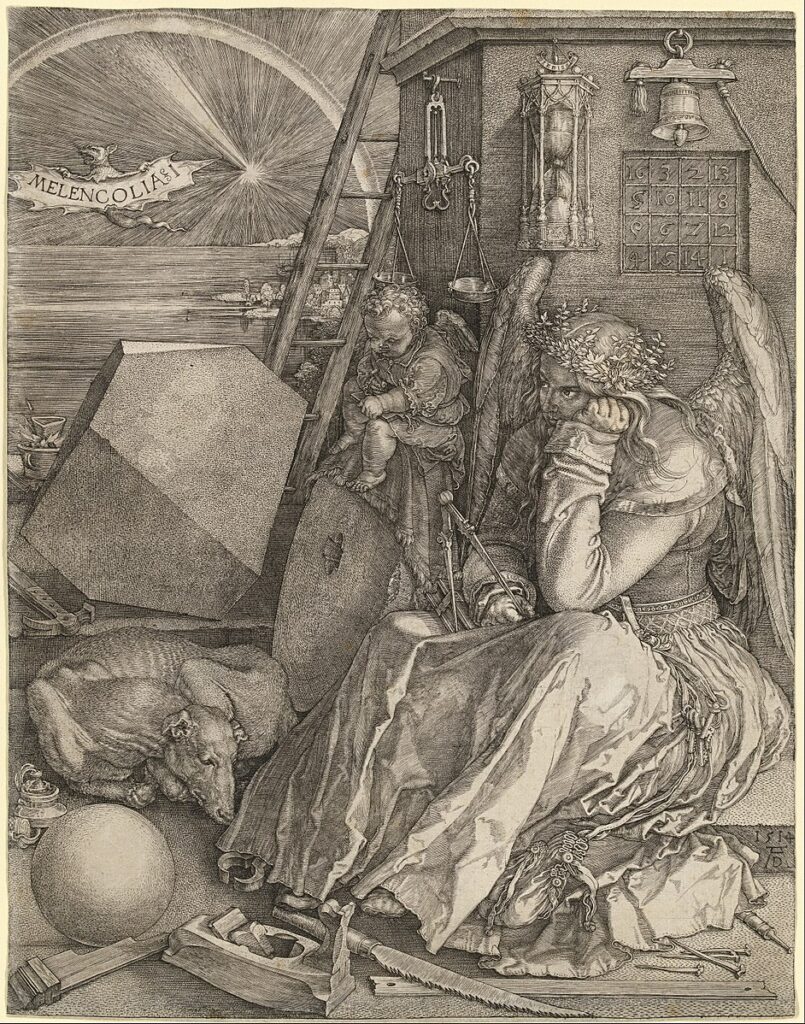
Melencolia, copper engraving, 1514
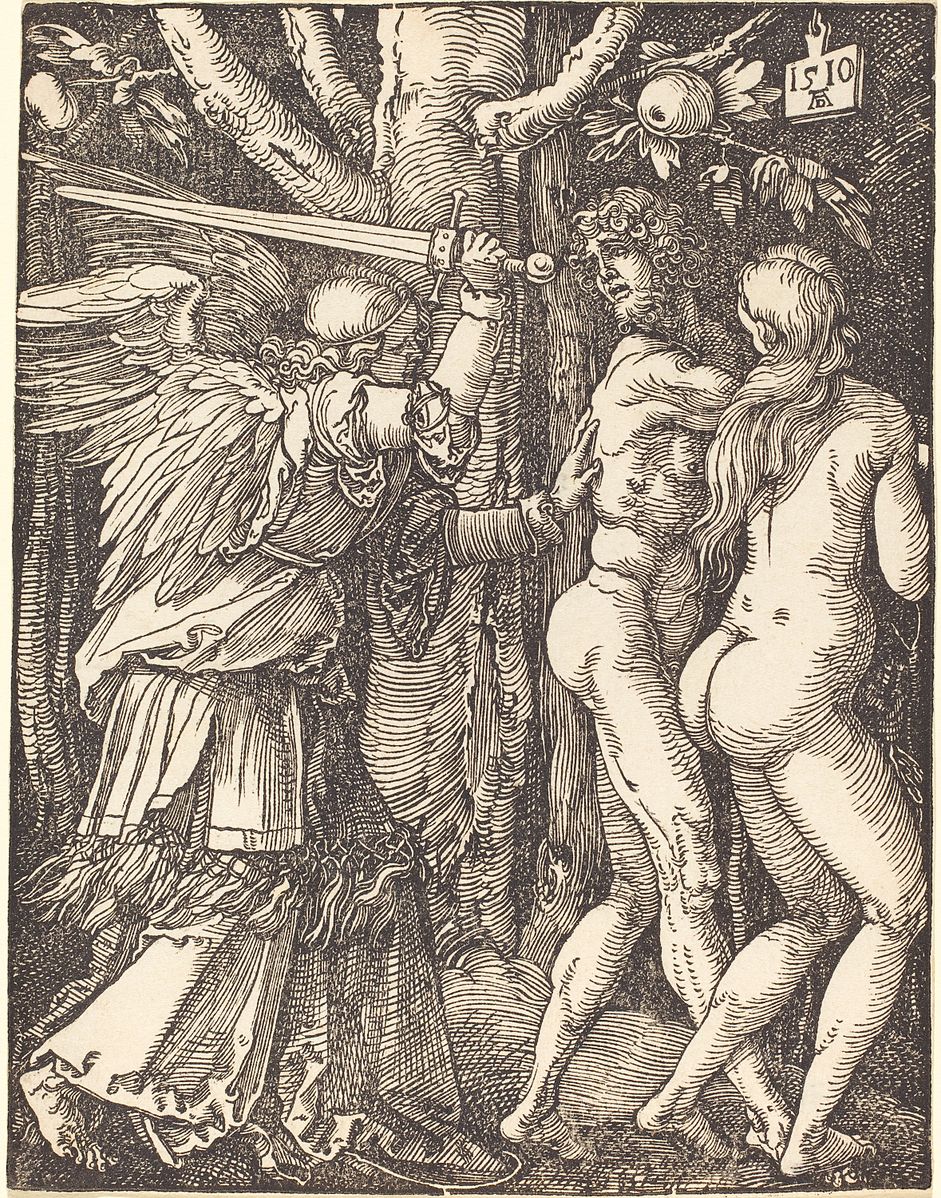
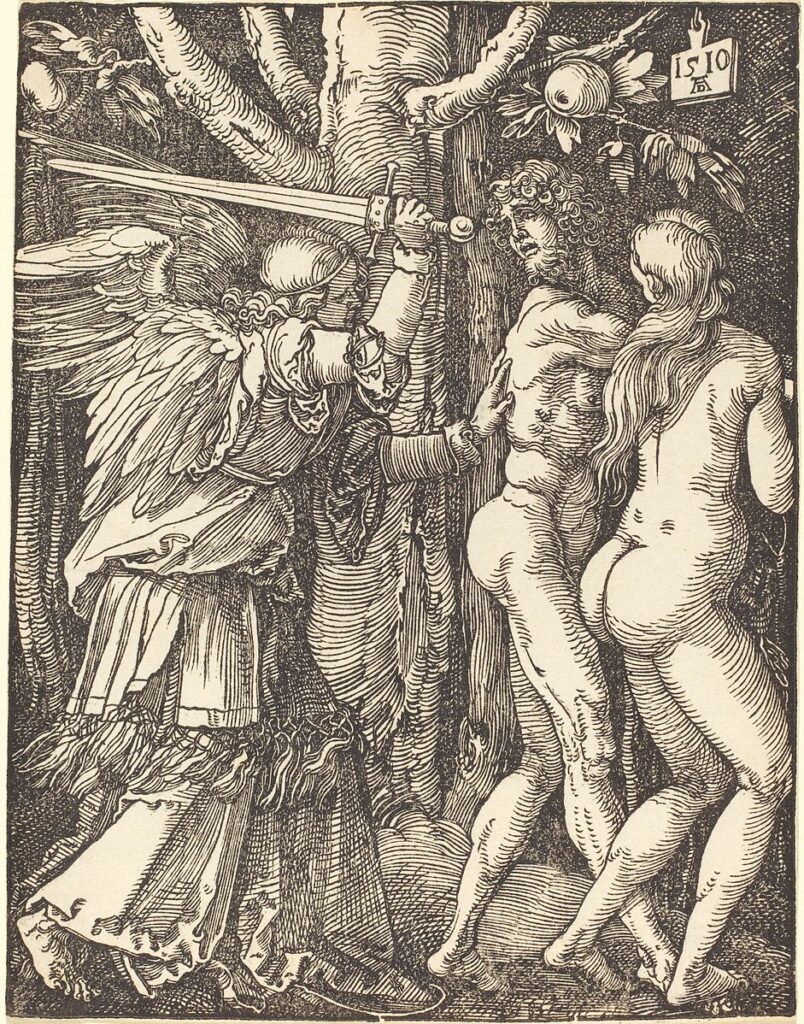
The Expulsion from Paradise, from The Small Passion, woodcut print, 1510
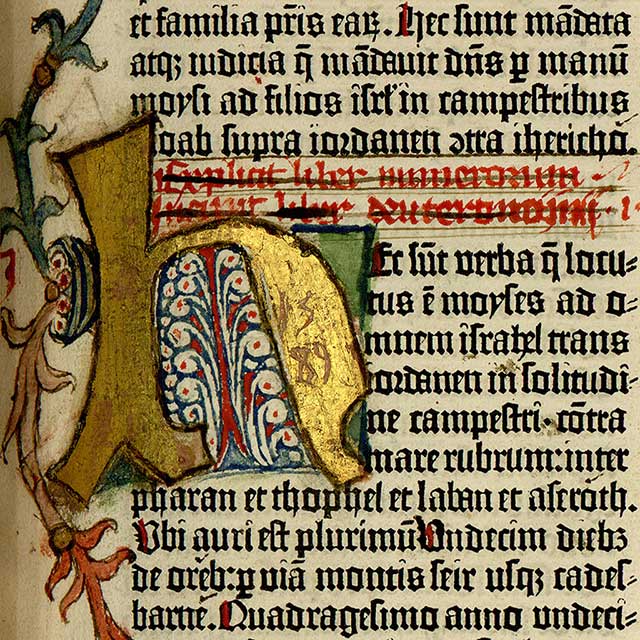
Biblia latina, commonly known as the Gutenberg Bible. (Mainz, Germany: Johann Gutenberg and Johann Fust, between 1454 and 1456)
In Mainz, Germany, in the mid-1450s, Johann Gutenberg and his partner Johann Fust published more than 150 large-format copies of the Bible in Latin. This is the book known today as the Gutenberg Bible. Gutenberg may have begun developing a new printing technology as early as the 1430s, and completion of the Bible demonstrated the viability of a press that used individual pieces of metal type to mass-produce books. Although books would continue to be written by hand in the years— and centuries—that followed, the printing process pioneered by his team became increasingly prevalent, helping change how information traveled in Europe and, later, the world.
The Ransom Center’s copy represents one of only 20 complete copies in the world that survive intact. Printed on paper, the two volumes remain in early bindings and feature text and decoration added by hand. In the first volume, books of the Bible begin with two types of distinctive, colorful letters. The second volume features more traditional red and blue initials. Acquired in 1978, this Gutenberg Bible is always on view and can be accessed in its entirety below.
Biblia latina, commonly known as the Gutenberg Bible. (Mainz, Germany: Johann Gutenberg and Johann Fust, between 1454 and 1456)