Category: Italian 15th-16th Books

  • Recyell of the Histories of Troy, Caxton, 1473-4

    Recyell of the Histories of Troy, Caxton, 1473-4

    LE FEVRE, Raoul (fl. 1464). Recuyell of the Histories of Troy. Translated from French into English by William Caxton (c. 1420-1491). [Bruges:] William Caxton, [1473 or 1473-early 1474].

    Chancery 2° (268 x 191 mm). Collation: [1-1410 158 (1/1 blank removed, 1/2r title printed in red hEre begynneth the volume intituled and named the recuyell of the historyes of Troye, composed and drawen out of dyverce bookes of latyn into frensshe by … Raoul le ffevre. preest and chapelayn unto … Phelip duc of Bourgoyne of Braband etc In the yere … a thousand foure honderd sixty and foure, And translated and drawen out of frenshe into englisshe by Willyam Caxton mercer of ye cyte of London, at the comaundement of … Margarete … Duchesse of Bourgoyne … begonne in Brugis in the Countee of Flaundres the fyrst day of marche … a thousand foure honderd sixty and eyghte, And ended and fynysshid in the holy cyte of Colen the. xix. day of septembre … a thousand foure honderd sixty and enleven, 1/2v Caxton’s prologue, incipit: [W]Han I remembre that every man is bounden, 1/3v Le Fèvre’s prologue, incipit: Whan y behold and knowe the oppynyons of the men, 1/4v heading to bk. I printed in red The begynnyng of this book sheweth the Genelagye of Saturne, 1/5r text, incipit: What tyme alle the Children of Noe were sprad, 15/8v explicit: Thus endeth the first book of the recueyll or gadryng to geder of the historyes of Troye); 16-2410 258 266 (16/1r Hiere begynneth the seconde booke … that speketh of the prowesses of the stronge Hercules, 26/6r explicit, 26/6v blank); 27-3610 (27/1r In these two bokes precedente. we have … tretyd of the two first destruccyons of Troye … Now in the thirde and laste book god to fore. we shall saie how … the sayd cyte was totally destroyed, chapter-heading printed in red How the kynge Priant reediffied the cyte of troye, incipit: For to entre than in to the matere, 36/9r Caxton’s epilogue, incipit: Thus ende I this book whyche I have translated … myn eyen dimmed with overmoche loking on the whit paper … Therefore I have practysed and lerned at my grete charge and dispense to ordeyne this said book in prynte … and is not wreton with penne and ynke as other bokes ben, to thende that every man may have them attones. ffor all the bookes of this storye … thus enpryntid … were begonne in oon day, and also fynysshid in oon day, 36/10r Latin verse attributed to HILDEBERTUS (1st half 12th century, Archbishop of Tours), incipit: Pergama flere volo. fata danais data solo, 36/10v blank)]. 344 leaves (of 352; lacking the blank first leaf, sheet 2/1.10 and fos. 19/3-7 supplied in pen-and-ink facsimile by J. Harris at the time of rebinding); fo. 19/8 probably and fos. 1/2-3 just possibly supplied from another copy at the time of rebinding.

    Paper from six different stocks, but there are two principal runs: the first from Piedmont with watermark of a bunch of grapes with looped stem (Stevenson/Briquet pl. *A3), the second from Vosges with bull’s head/Tau watermark (variant of Piccard II Abt. X 13-19); the rest are essentially stray sheets: w/m mermaid (Briquet 13859), arms of France, bull’s head/X, gothic P. The paper sequence seems to indicate that the edition, set in three composition units, was printed concurrently on two presses; a set of six pins kept the sheet in position over the forme (the four outermost pinholes are visible in the corners of most sheets, the central pair remains mostly but not always hidden in the gutter). Bastarda type 1:120, presumably cut and supplied by Johann Veldener. 31 lines. Title and two headings printed in red. Rubricated in an early hand: initials, paragraph marks, some capital strokes; 7-line initial W to start the text painted in liquid gold and outlined in red (probably somewhat later). Quiring in early manuscript. (Upper outer corner of title and following leaf torn away and restored with the missing text supplied in pen-facsimile; a few other repairs, mostly marginal, otherwise in unrestored condition; slight soiling in places and occasional minor stains, but the copy is unwashed and the paper fresh.) English gold-tooled binding by Charles Lewis, c.1833, blue morocco over heavy pasteboard, wide border on sides built up from small tools including flowers, crowns, acorns, stars and dots, compartments of spine decorated with the same tools and lettered, roll-tooled border on turn-ins, gilt edges.

    Provenance: ?Agnes Cole 1518 (De Ricci 3.19), but there is no evidence for this ownership — Tresham family By me Thomas Trisham (inscription on final blank page), probably Sir Thomas Tresham of Rushton (fl. 1500, d. 1559, sheriff, MP for Northamptonshire); John Trishem (entry below the heading to bk. I), perhaps John Tresham of Rushton, Northants (d. 1546, son of Thomas); a signature that could be read as MA Tresham, perhaps Mary Tresham (d. 1597, John’s daughter) The Sir Thomas Wriothesley – King George III – B.L. copy of another Caxton translation, the second printed book in English (Bruges: 1474), Jacobus de Cessolis’ The Game and Play of Chess, was also owned by one of the Northamptonshire Treshams, very probably George Tresham, MP, who was probably in the household of Edward VI as prince. — John Skinner of Bristol (early inscription on 22/8v) — Delaroy (early inscription on 32/1r) — John Benet(?) (early inscription on 34/8v) — a variety of early English manuscript marginalia and calculations, including receipts of payment for wines naming a Mr. Smith and John Savery — Henry ?Sperke (ownership inscription in a late-16th/early-17th-century hand on b6v) — Beriah Botfield, purchased in 1833 from Payne and Foss for £168 (P. & F. Acquisitions p.77).

    THE FIRST BOOK PRINTED IN ENGLISH AND THE FIRST PRODUCTION FROM CAXTON’S FIRST PRINTING SHOP. Caxton’s Bruges press was the second to be established in the Burgundian Netherlands after that of Johannes de Westfalia and Thierry Martens in Alost; the market for the Bruges printers (wealthy courtiers reading vernacular chivalric literature) was very different from that of the Alost and Louvain printers (cheap Latin texts for university readers). Le Fevre’s medieval version of the Trojan cycle is based more on Dictys (4th century), Dares (5th century), Benoît de Sainte-More (12th century) and Guido delle Colonne (13th century) than on Homer and also recounts at great length the exploits of Perseus and Hercules; he dedicated the work to Philip the Good, just as some years later his translator would dedicate it to Margaret, Duchess of Burgundy.

    Before England’s first printer set up shop in 1476 within the precincts of Westminster Abbey, he had been active on the continent as merchant, diplomat, translator, publisher and printer. It was during his semi-exile in Cologne that Caxton was first confronted with the newly invented art of printing. In 1471-72 he commissioned from a local press, run by Johann Schilling, three Latin books of English origin (VK 296, VK 218, VK 501 in that order, see P. Needham, “William Caxton and his Cologne partners,” in: Ars Impressoria, Festgabe für Severin Corsten, 1986, p. 103-131), and there he met the typefounder and printer Johann Veldener, who later supplied the first type to be set in England. Also while in Cologne, the wealthy entrepreneur from Kent finished the translation of the Recueil des histoires de Troie, his first great literary effort, with which he had persisted since 1468 at the command of Margaret of York, sister of Edward IV of England and wife of Charles the Bold of Burgundy. Caxton then returned to Bruges where he printed at least six books (2 in English, 4 in French), starting off with the Recuyell.

    Eighteen copies are extant, only two of which are complete (British Library, Morgan Library). The most important surviving copy is in the Huntington Library (ex-Roxburghe-Chatsworth), with the unique dedication engraving inserted. Five other copies remain in private hands (Marquess of Bath [Sir John Thynne’s copy, at Longleat since no later than the 1540s], Paul Mellon, Scheide Library, Duke of Northumberland, Fitzwilliam [not in De Ricci, sold Christie’s, 8 July 1998, lot 1]). Very small fragments are located in four American (3 originally belonging to the same copy; the Robert Taylor fragment at Princeton not in De Ricci) and four English libraries. The only (and excellent) census was published in 1909 by Seymour de Ricci. Since then the following changes of ownership have occurred: DeR 3.5 Cambridge UL now Paul Mellon, 3.10 Sion College now Keio University, Japan, 3.11 Duke of Devonshire now Huntington Library, 3.12 Earl of Pembroke now Texas UL, 3.13 J. Pierpont Morgan now Scheide Library, 3.16 Fitzroy Fenwick now Duke of Northumberland; 3.19 “owner untraced” is the copy here offered for sale; 3.25 one of the four sets of 2 ff. “untraced” now Yale UL. The only copy located outside England and the United States is in Paris B.N., lacking 52 leaves (DeR 3.9).

    Literature: Ames-Herbert I, p. 5-9; Ames-Dibdin I, p. 16-28; HC 7048; Blades 1; CA (I) and KC II 1093a; Pr 9322; A.W. Pollard, Morgan 634; Duff 242; STC 15375; Pforzheimer 594; Oates 3837-8; BMC IX, 129 (IB. 49431); Goff L-117; Cinquième Centenaire 82; Blake (1976) pp. 107-108, 197; Painter pp. 45-48, 51-54, 59-64; Hellinga (1982) pp. 29-31, 48; CIBN L-83; Needham (1986) Appendix D, Cx 4 (incorr. coll.).

  • De civitate dei. Sweynheym and Arnoldus Pannartz, 1470

    De civitate dei. Sweynheym and Arnoldus Pannartz, 1470

    AUGUSTINUS, Aurelius (354-430, Saint). De civitate dei. Rome: Conradus Sweynheym and Arnoldus Pannartz, 1470.

    Super-median 2o (370 x 240 mm). Collation: [1-28 3-510 6-88 9-1110 12-148 15-1810 19-208 21-2310 24-268 27-2810 2912 3010 318 3210]. 290 leaves (of 294; without the 4 blanks). 46 lines. Roman type 2:115. Rubricated in alternate red and blue, initials with delicate pen-flourishing, book numbers supplied in red in upper margin. FLORAL-PAGE BORDER incorporating 15-line initial I and 9-line initial G, illuminated in gold and colors by a contemporary hand, and 21 other illuminated initials. (Repaired tear on 1/2 touching letters, small marginal repair on 3/1 affecting border, 26/6-7 with small stain in lower margin, some worming catching letters, heaviest at end, occasional mostly marginal spotting, a few book numbers shaved.) 19th-century panelled vellum gilt over wooden boards, morocco lettering-pieces. Provenance: “Pertinet ad locum Crucis Calle Caserte” (inscription on 1/2) — Alexander James Beresford Hope (1820-1887), English politician, author and ecclesiatical historian (gift inscription, dated St. Peter’s Day, 1848, on front flyleaf, presenting the book to) — Rev. E. Coleridge — C.W. Dyson Perrins (booklabels; sold Sotheby’s London, 17 June 1946, lot 30 to Maggs Bros., London, for £300) — Estelle Doheny (morocco bookplate; purchased from Maggs Bros.) — donated to SMS 12 September 1947.

    THE FINE DYSON PERRINS COPY. Third (second Roman) edition. After having established a press at the Benedictine monastery at Subiaco, Sweynheym and Pannartz moved their second printing shop to Rome in 1467 at the Palazzo Massimo, most likely at the behest of the great humanist, Cardinal Bessarion. Bessarion’s secretary, Giovanni Andrea Bussi, soon became chief editor of the press (and later papal librarian), directing its printing program of humanistic texts. Sweynheym and Pannartz had already printed the first edition of De Civitate Dei at Subiaco in 1467 (Goff A-1230), and again in Rome in 1468 (Goff A-1231).

    “Few men have influenced human thought as Augustine did Western religion and philosophy” (DSB). Written as a defence of Christianity against pagan critics who viewed the sack of Rome as punishment for the abandonment of the old gods, Augustine’s magnum opus presented a dialectical view of human history that profoundly marked Western thought. BMC IV, 10 (IC.17149); BSB-Ink. A-854; GW 2876; HC *2049; Pollard Perrins 3 (this copy); Pr 3310; Goff A-1232.

  • Anthony Koberger

    Anthony Koberger

    Anton Koberger[1] (c. 1440/1445 – 3 October 1513) was the German goldsmith, printer and publisher who printed and published the Nuremberg Chronicle, a landmark of incunabula, and was a successful bookseller of works from other printers. In 1470 he established the first printing house in Nuremberg. Koberger was the godfather of Albrecht Dürer, whose family lived on the same street.

    Of Koberger’s many different printed editions which he produced from the late 15th century to the early 16th century, three stand out in particular. He printed an illustrated edition of the Bible in High German in 1483, complete with many remarkable woodcut illustrations. The text is from the first German Bible printed by Günther Zainer in the 1470s.

    oberger also printed an edition of the Golden Legend by Jacobus de Voragine in German in 1488, also illustrated with woodcuts of saints and religious themes.[7] His most celebrated project is the so-called Nuremberg Chronicle of 1492, or Liber Chronicarum, probably the most extensively illustrated edition of the incunabula period, c. 1450–1500. Editions were produced in both Latin and German. The work was so popular, it is believed by scholars to have had one of the largest print-runs of the Incunabula Period. Because of the popularity, pirated editions appeared almost immediately after Koberger’s edition.[8]

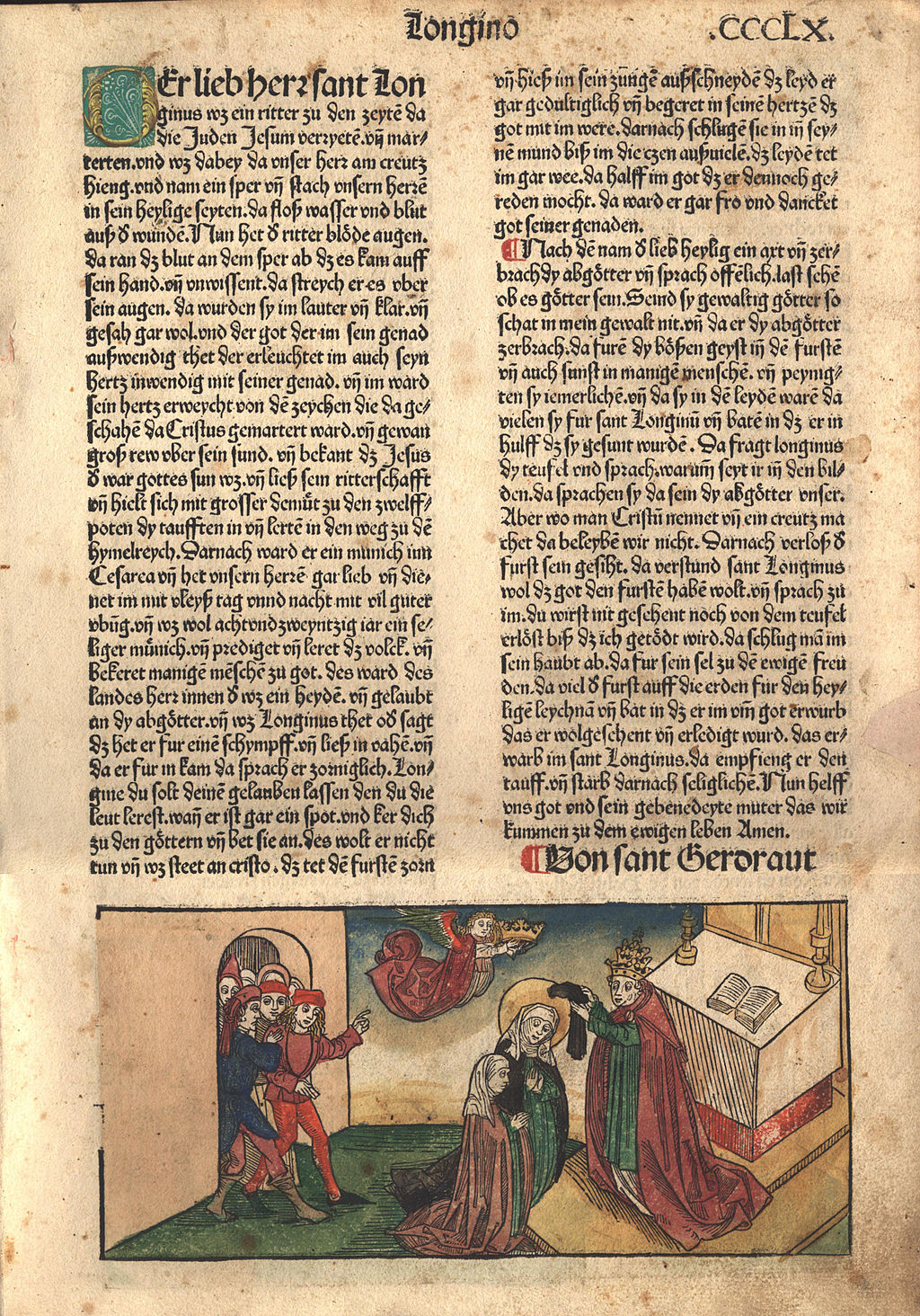
    Folio Page from “The Golden Legend” printed by Anton Koberger, 1488. The image depicts a saintly woman being anointed, possibly St. Mary or any number of other female saints.

    A page from the Nuremberg Chronicle, leaf 25 (page 49) printed by Anton Koberger circa 1492.

  • Peter Schöffer

    Peter Schöffer or Petrus Schoeffer (c. 1425 – c. 1503) was an early German printer, who studied in Paris and worked as a manuscript copyist in 1451 before apprenticing with Johannes Gutenberg and joining Johann Fust, a goldsmith, lawyer, and money lender.[1]

    Among his best-known works are the 1457 Mainz Psalter, the 1462 Bible or Biblia pulcra, and the 1484 Herbarius latinus.

  • Historia naturalis, 1476, Jenson

    Historia naturalis, 1476, Jenson

    PLINIUS SECUNDUS, Gaius (23-79). Historia naturalis, in Italian. Translated by Cristoforo Landino (1424-1492). Venice: Nicolaus Jenson, 1476.

    PLINIUS SECUNDUS, Gaius (23-79). Historia naturalis, in Italian. Translated by Cristoforo Landino (1424-1492). Venice: Nicolaus Jenson, 1476.

    Royal 2° (413 x 265mm). Collation: [1-2110 22-268 27-3510 3610(10+1) 378 3810 398 40-4110 428 4310] (1/1 blank, 1/2r translator’s prologue, 1/5v blank, 1/6r book I, 3/1v blank, 3/2r book II, 43/9v colophon, 43/10 blank). 413 (of 415, without first and final blank leaves); sheet 15/5.6 misbound at centre of quire 26. 50 lines. Type: 1:115R, scattered Greek. ILLUMINATED BY A VENETIAN ARTIST IN THE CIRCLE OF GIROLAMO DA CREMONA, BENEDETTO BORDON AND THE THE MASTER OF THE SEVEN VIRTUES in camaieu gris, full-page architectural border opening Book II incorporating the arms of the Bollani family of Venice, 8 scholars in lower border with mythical beasts, the text page a fictive banner, initial miniature of a warrior holding his shield, 11-line historiated initials in classical style opening each book, also in camaieu gris on a red, green or blue ground, minor initials alternating in red, blue or green, foliation in two early hands (showing that the misbinding of 15/5.6 must be original), book numbers added to headline in a 17th-century Italian hand. (First leaf lightly soiled, section of blue-painted border of frontispiece restored, a few other extreme foremargins at beginning and end expertly strengthened, occasional light stains, a few small wormholes at front, marginal tear in 3 leaves, last leaf torn and repaired.) 18th-century sprinkled calf, gilt spine, red leather spine label, red sprinkled edges (sides scuffed, hinges and spine worn); modern blue cloth box. Provenance: Candiano Bollani, Venice (c.1413-1478; illuminated armorial; see below) — Thomas Herbert, 8th Earl of Pembroke (1656-1733, First Lord of the Admirality, Lord Privy Seal, Lord High Admiral; in the 1776 list of his early books prepared by Thomas Dampier and published in Dibdin’s Bibliographical Decameron, III, p.290; by descent, Pembroke sale Sotheby’s, 25 June 1914, lot 159,£225 to:) — Tammaro de Marinis (sale Hoepli, Milan, part 2, 30 November 1925, lot 317) — Otto Vollbehr (bookplate, duplicate stamp) — Robert Williams (bookplate).

    FIRST EDITION IN ITALIAN, ILLUMINATED BY A CONTEMPORARY VENETIAN ARTIST FOR CANDIANO BOLLANI. The decoration of the Bollani Pliny is characteristic of Veneto-Paduan Renaissance illumination popular with wealthy humanist book-collectors in the 1470s and 1480s. The illusionism and imagery of its architectural frontispiece’s triumphal Roman arch with all’antica motifs, including fictive cameos, cornucopiae, masks and satyrs, from which is suspended a ragged piece of parchment, and historiated initials drawn and painted in grisaille, skillfully evoke the Classical era. The illuminator was a Venetian artist in the circle of Girolamo da Cremona, Benedetto Bordon and the Master of the Seven Virtues, three of the most accomplished miniaturists of incunables active in Venice in the 1470s and 1480s. His style incorporates elements of their work: Girolamo’s distinctive reclining deer and lions in a stony landscape strewn with bound books, and Bordon’s trompe l’oeil rock crystal initials on monochromatic floral grounds, and the anonymous master’s aged male figures with expressive and bearded faces, dressed in deeply-folding drapery. This combination of influences reflects the fact that the trio worked in collaboration with each other, as well as individually, such as for the illumination from 1477-1481 of a magnificent series of legal texts printed by Jenson, for Jenson’s business associate Peter Ugelheimer of Frankfurt (Gotha, Landesbibliothek, Mon. Typ. 1477, 2.4, 2.10, 2.12, 2.13; see The Painted Page, ed. by J. J. G. Alexander, 1994, nos. 96-98, and Andrea De Marchi, in Parole dipinte: la miniatura a Padova dal Medievo al Settecento, ed. by G. Canova Mariani, 1999, nos. 145-148).

    Three other books from the library of the Bollani, a patrician family of Venice, are known. One, a manuscript, contains Candiano’s coat-of-arms together with that of his wife, Lucrezia Marcello. Two others (a manuscript Petrarch, Poiano: 1476, and a Bible printed on vellum, Venice: Jenson, 1479) were illuminated by artists associated with Jenson: the Pico Master, and the Pico Master with another artist in the circle of Bordon (Armstrong, Studies of Renaissance Miniaturists in Venice, 2003, pp. 53, 320, 322). Since the Bible was printed the year after Candiano’s death, it was presumably owned by one of his sons, Domenico, Francesco or Girolamo. Dispersals from the Bollani library commenced already in the 15th century, as witnessed by the later ownership of the manuscript by Nicoletto Vernia (d. 1499), and continued into the 18th century.

    The 1476 Pliny is a masterpiece of typographic design, printed with Jenson’s influential Roman types and in proportions that continue to be emulated today. The Bollani copy joins a handful of other deluxe copies illuminated for grand patrons such as the Ridolfi of Florence and others associated with its production. The translation and printing of the edition was commissioned by the Strozzi, the powerful Florentine banking family, in conjunction with Giovambattista Ridolfi. Ridolfi and Girolamo Strozzi remained in Venice during the printing of the edition, and Ridolfi took delivery of copies by September of that year. (Cf. F. de Roover, “Per la storia dell’arte della stampa in Italia”, La Bibliofilia, 55, 1953, 107-117.)

    A large copy with pinholes frequently visible at lower corner. Sheet 42/3.6 variant with heading of chapter XX on 42/3r reading ‘Ematite et schisto’. H *13105; BMC V, 176 (IC. 19693-4); CIBN P-469; IGI 7893; BSB-Ink. P-611; Bod.Inc. P-372; Klebs 787.1; Goff P-801.

  • Historiae Florentini populi Jacobus Rubeus, 1476

    Historiae Florentini populi Jacobus Rubeus, 1476

    BRUNUS ARETINUS, Leonardus (1369-1444). Historiae Florentini populi in Italian, translated by Donatus Acciaiolus (1429-1478). Venice: Jacobus Rubeus, 12 February 1476.

    First edition. Bruni, one of the most celebrated humanists between Petrarch and Erasmus, presents Florence as heir of the free city-states of ancient Etruria and of the Roman Republic. It contains the earliest printed account of the life of Dante and other biographies and anecdotes interspersed throughout the chronicle. This copy was formely owned by John Francis Neylan. In a high-profile career, Neylan was notably William Randolph Hearst’s general counsel and advisor. His bookplate was designed by W.H. Wilke and printed by John Henry Nash. HC *1562; BMC V, 215; GW 5612; IGI 2202; CIBN B-883 ; BSB-Ink B-945; Bod-inc B-575; ISTC ib01247000; Goff B-1247.

    Median folio (315 x 223mm). 217 leaves (of 218, without blank a1). Initial spaces, some with guide-letter (modest holes repaired in first 3 leaves touching a few letters, one possibly a removed stamp, occasional light stain or spotting). 20th-century vellum. Provenance: early marginal annotations – ‘J.B. Bonensis’ (17th-century inscription in first initial space) – John Francis Neylan (1885-1960; American lawyer, newspaper publisher, educationalist; 20th-century bookplate) – [sold Christie’s, Paris, 29 Nov. 2011, lot 34].

  • Nicolas Jenson

    Nicolas Jenson

    Nicolas Jenson and the success of his roman type, Riccardo Olocco, April 4, 2017.

    During the 1470s Nicholas Jenson’s technical skill and business acumen helped establish Venice as Italy’s publishing capital and in centuries since he has been celebrated for perfecting roman type, the rebirth of Latin inscription.

    Jenson’s fame as one of history’s greatest typeface designers and punch cutters rests on the types first used in his edition of Eusebius’s Praeparatio Evangelica, which presents the full flowering of the roman type design.[8][9]

    In 1471, a Greek typeface followed, which was used for quotations, and then in 1473 a Black Letter typeface, which he used in books on medicine and history.

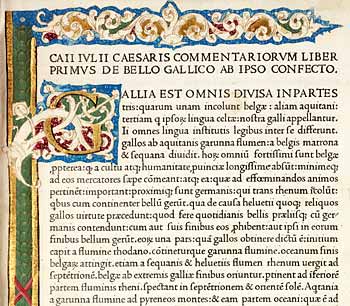
    Caesar, Julius. Works, 1471. Printed in Venice by Nicolas Jenson, 1471
    Nicolas Jenson printed one of the earliest and most beautiful editions of Caesar. We note here, especially the remarkable clarity and simplicity of the printer’s Roman typeface, which drew its inspiration from etchings on Roman monuments. On this opening page, we are also treated to a wonderful illuminated initial and border.[14]


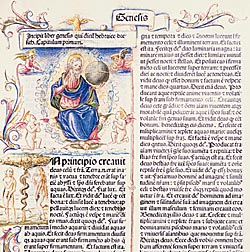
    VK 405, Bible in Latin, Nicolas Jenson, Venice, 1479
    The Bible was written by forty different human authors over a 1500-year period. While the original Autographs were “perfect”, the process of hand-copying resulted in derivations from the original texts. Of the French printers of the era from Nicolas Jenson came nearly a hundred of the finest books produced in the fifteenth century. This is the first Bible to be issued from Jenson’s press, of this Latin Bible, issued in 1479, Pope Sixtus IV conferred upon him the honorary title of Count Palatine.[15]


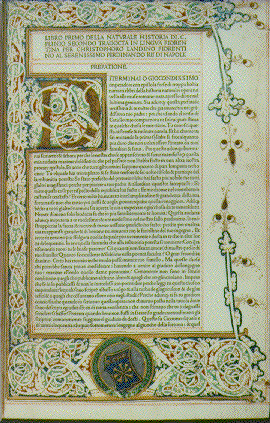
    Pliny, Natural History, 1476. Printed in Venice by Nicolas Jenson. 1,025 copies (1,000 paper, 25 vellum).
    The Pliny the Elder text was printed as a partnership venture between Jenson and the Strozzi family, who backed the venture financially. It is a vernacular text, with translation by Cristoforo Landino. “The Pliny text was printed (in a font closely simulating the modern humanist handwriting in which the manuscript of the work might have been written) with wide margins, without initial capital letters at the beginning of chapters, and with its titles isolated in a sea of blank paper on the frontispiece, crying out for illustration and decoration.”[16]

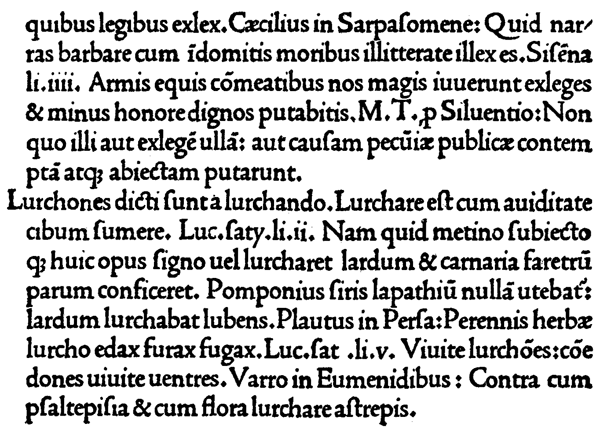
    Roman type of Nicholas Jenson, 1472.

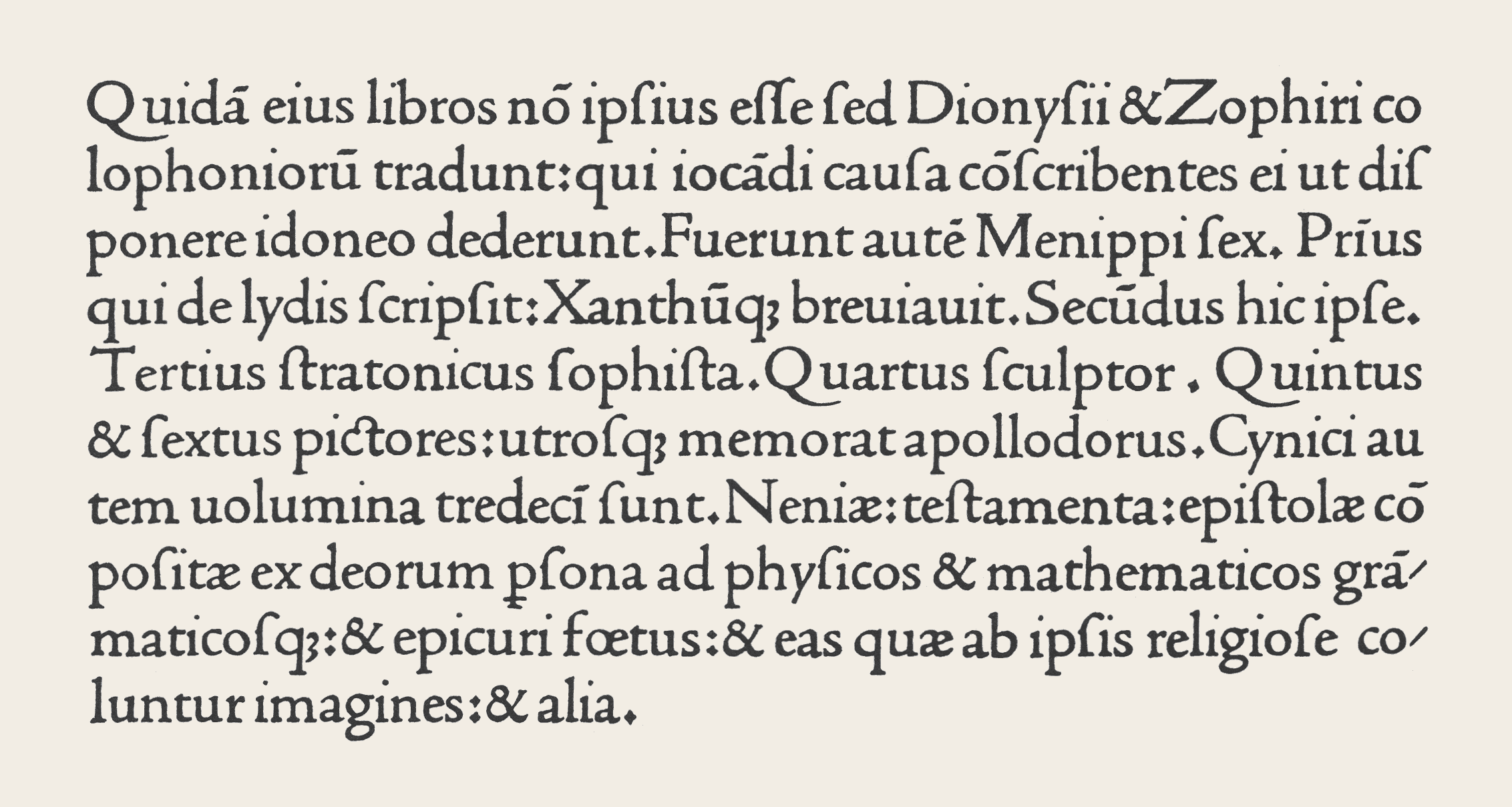
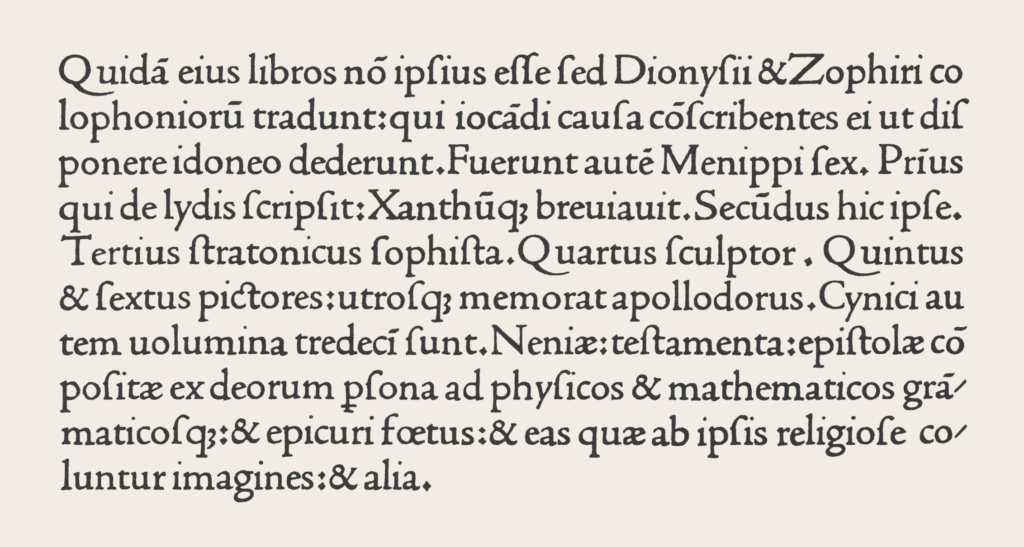
    A specimen of Nicolas Jenson’s archetypal roman typeface, from the “Laertis”, published in Venice c. 1475.

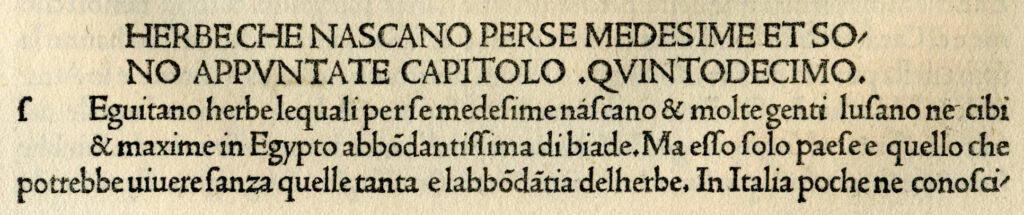
    Capitals of Nicolas Jenson’s roman typeface, from a translation ‘in Fiorentina’ (in Italian) of Pliny the Elder, published in Venice in 1476.

    Julius Caesar’s Works, printer Nicolas Jenson, 1471

    VK 405, Bible in Latin, Nicolas Jenson, Venice, 1479

    Pliny the Elder’s Natural History, printer Nicolas Jenson, 1476

  • Günther Zainer

    the first printer in Augsburg, where he worked from 1468 until his death; he produced about 80 books including two German editions of the Bible and the first printed calendar. He came to Augsburg from Strassburg and printed in 1472–76 three large works of moral instruction. He also printed the first large illustrated book, Jacobus de Voragine’s Legenda aurea in 2 volumes with 131 woodcuts, 1471–76. Johann Zainer, the first printer in Ulm, was probably his brother.

    In 1468 Meditationes vitae domini was the first book he is known to have printed. The German edition of the Legenda Aurea of Jacobus de Voragine, was the first illustrated book he printed. In 1471/72 Zainer made the first printed edition of the extremely popular Der Heiligen Leben.[2] In 1472 appeared the Etymologiae of Isidore of Seville About 1475 he printed a German edition of the Bible, with a second edition in 1477.

    Günther Zainer’s printing was of high quality, as to paper, presswork and typefaces: 32 illustrated books and broadsides with altogether 100 illustrations testify to his interest in decoration. His first German Bible is decorated with 73 ornamental initials.

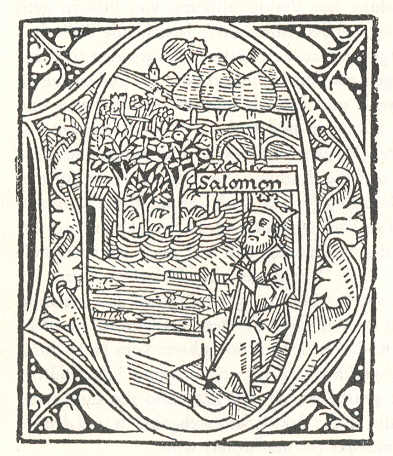
    Initial from the German Bible, printed by Zainer in Augsburg in 1477

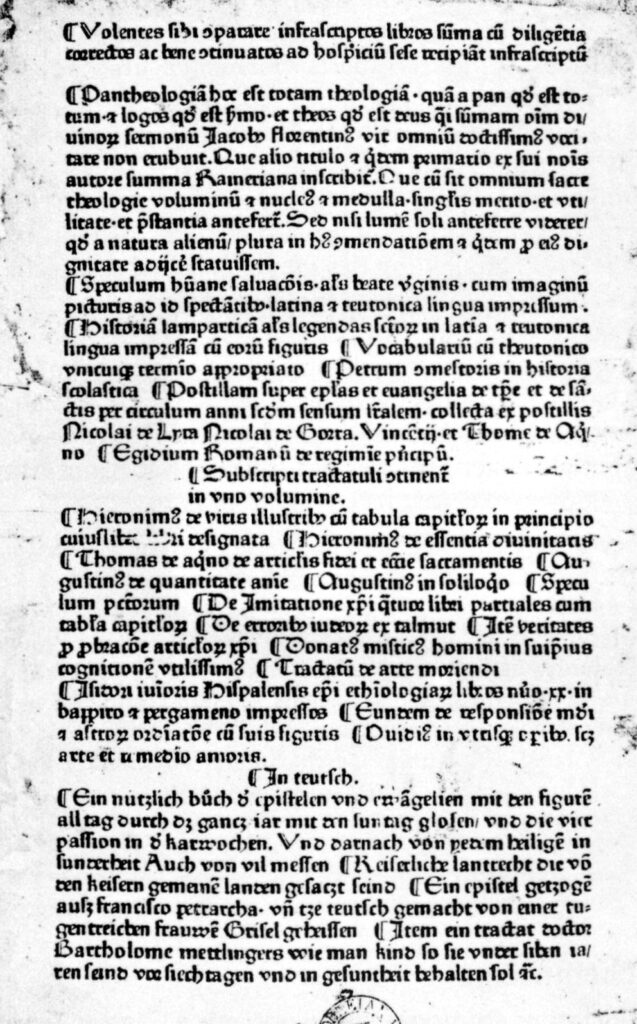
    Printed list of works printed by Zainer, ca. 1480

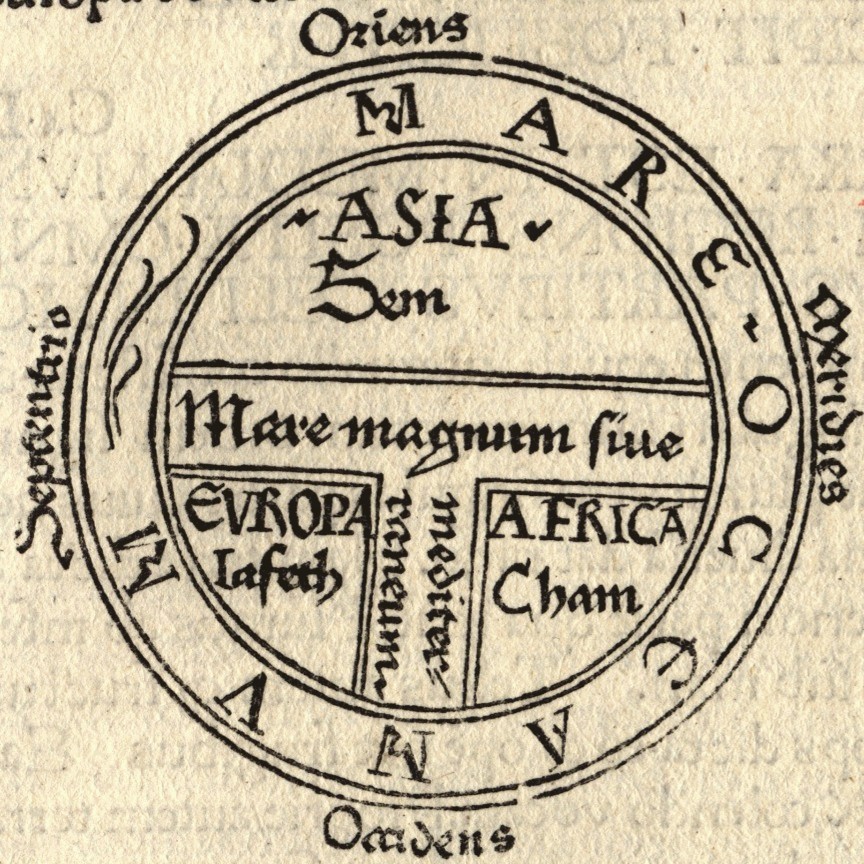
    Earliest printed example of a classical T and O map (by Günther Zainer, Augsburg, 1472), illustrating the first page of chapter XIV of the Etymologiae of Isidore of Seville (it shows the continents as domains of the sons of Noah: Sem (Shem), Iafeth (Japheth) and Cham (Ham)).

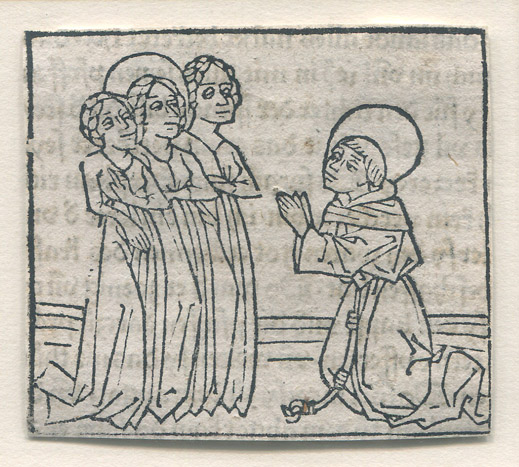
    Early woodcut print of a saint kneeling before three women by Zainer, circa 1473.

  • Johannes Mentelin

    Johannes Mentelin

    Since at the end of the 1450s, when Mentelin founded his Strasbourg printery, there was still no other place where printing was done besides Mainz, 

    The first printing which carries Mentelin’s name is Augustine’s Tractatus de arte praedicandi from the year 1465. However, it is assumed that Mentelin had already begun to print significantly earlier, probably even already in 1458. His oldest known printed work is a Latin Bible printed with 49 lines per page (“B49”), whose first volume is dated 1460. As Gutenberg’s Bible was printed with 42 lines per page, Mentelin’s had fewer pages and proved handier.

    About 40 printed works are ascribed to Mentelin’s Strasbourg Offizin. His printing and publishing list contained predominantly theological and philosophical works in Latin, whose purity of text was ensured by scholarly proofreaders. Among others, works of Augustine, Thomas Aquinas, Aristotle, John Chrysostom, Isidore of Seville and Albertus Magnus were issued. In 1472 he published the Postilla super totam Bibliam, Nicolaus de Lyra’s commentary of the Bible. Mentelin also published texts of classical antiquity (such as Virgil’s Opera and the Comoediae of Terence). As the only German book printer, Mentelin printed Medieval court literature, such as Wolfram von Eschenbach‘s Parzival and Der jüngere Titurel (“The Younger Titurel”) of Albrecht von Scharfenberg.

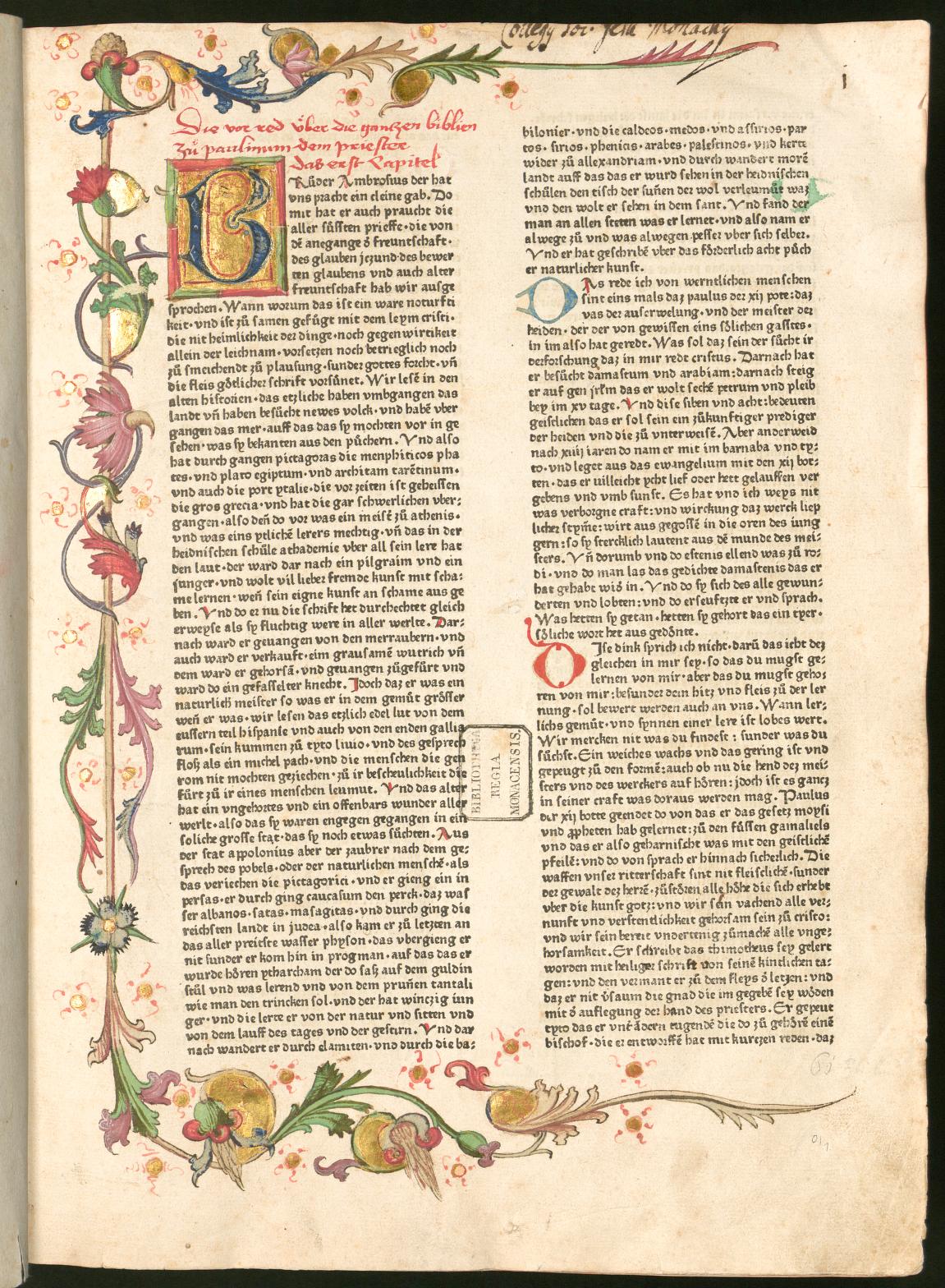
    His first printing of a Bible in vernacular language stands out, the so-called Mentelin Bible of 1466, the first attested edition of the full Bible in the German language, translated from the Vulgate, and one of the earliest printed works in German. The Mentelin Bible was the basis for a further thirteen pre-Reformation editions of the Bible (including those by Zainer and Sorg) which appeared in southern Germany before editions of the Luther Bible, based on Hebrew and Greek, from 1522.